Friday, September 3, 2010

3 September 2010 Friday


Wow, today's weather is windy with big grey-white loomy clouds blowing fast with peeks of sunshine. It was chillier than we're used to..smile..all that warm weather has spoiled us and thinned our blood. The farm crew crowded inside the grainary and we all ate together. I love it, cozy and easy to talk to everyone.

Mary and Maureen helped as usual. Maureen and I made Greek tahini soup with tomatoes and horta, greens that I blanched 4 to 5 minutes in lots of water, drained, chopped and braised in lots of olive oil (I simmered sliced garlic and a little finely diced onion in the olive oil first, of course). At the end, I sprinkled the horta with salt and red wine vinegar. (I ran out of lemons and used Eden red wine vinegar, my fave.)

The Cretans are wild for horta. They have more than 300 varieties of edible wild greens--more varieties than anywhere else in Europe or the Mediterranean. Carol said that Cyprus is very much the same. Though Cyprus is nearer to Turkey (and half claimed by it) the people share the foraging mania. Can you imagine the phytochemicals (antioxidants and so on) that those folks must ingest? No wonder they are so long lived.

Mary has been making the best stuffed grape leaves that I've eaten in these parts, so she offered to make them with me. Husband Bill and I picked 90 wild grape leaves--pretty tough, but a 1 to 3 minute blanching softens them. Mary brought local lamb and beef and we all rolled them--about 80. It went fast with three sets of hands. She made the traditional avgolemono sauce for the topping too. These will definitely go into the textbook. I'm working on Greece and Turkey right now. Divine food. I haven't finished the recipe yet, but if anyone wants it, just email me a nallenchef@gmail.com and I'll post it here.

Lots of tomatoes, melons and greens today.

Greek Sesame Soup (Tahinósoupa)
6 servings

1-1/2 quarts water or vegetable broth (I use the cooking water from chickpeas)
5 to 6 large cloves garlic, minced
1/3 cup white long grain rice
2 cups peeled, seeded and diced tomatoes plus juices
1 to 1-1/2 lemons, zested and juiced
1/2 cup sesame paste (tahini)
1/4 cup finely chopped Italian parsley

Bring water or broth, garlic, rice and tomatoes to a boil and simmer until rice is tender, 15 minutes. Stir in lemon zest and remove soup from heat.

Whisk tahini with lemon juice and 1 cup hot broth until creamy. Pour tahini mixture back into rice-tomato-broth and mix well.

Taste soup and season with salt, freshly ground pepper and more lemon juice to taste. Serve soup hot sprinkled with parsley.

Friday, August 20, 2010

20 August 2010 Rain and Sun


This morning the rumbling in the West caused dogs to bolt and cats to shiver. Then, as a blessed summer day should, the pouring rain stopped and the sun came out. By the time we ate lunch at 1.15PM, it was almost hot, and very much August.

The menu today reflected the changing weather--warming, heating and cooling.

French green lentil soup
(with lots of garlic for flavor, kale and carrots, sauteed onions and tomatoes, which melted into it and a little "tempering" of minced garlic, lemon zest and oregano simmered in hot olive oil poured in at the last)

Indonesian chicken and Roma bean sambal with coconut and tomato
Brown basmati rice

Watermelon, tomato, feta and mint salad (more like a fresh chutney)
We poured in a little olive oil. The feta came from Mary Buschell's goats. YUM.

Kale falafel
These are delightful. I made beet falafel from the wonderful Silvena Rowe's book Purple Citrus and Sweet Perfume (available from Amazon.uk, but I revised it this week for the kale falafel and they came out very well.

Butternut squash hummus
The squash were a couple old fall ones from my cellar--they were dry and sprouted inside but not rotty. Peeled, cubed and roasted them--good flavor. Mashed 'em with tahini, lemon juice, garlic, sumac and za'atar.

Recipe today is for falafel. I can, with conscience, give it to you because I redid it in my own way and like it better.

Kale Falafel
15 to 16 2" to 2 1/2" cakes, 4 to 6 servings
This is a great recipe to improvise with your favorite vegetables and herbs. Change the seasonings--add oregano or parsley--or change the vegetable--substitute 1/2 pound beets or carrots, peeled, steamed lightly, drained and finely grated. For more texture, stir 1/4 cup mashed chickpeas into the falafel mixture.

1/2 pound stemmed kale (weigh after stemming)
2 tablespoons olive oil
2 cups finely diced red or sweet onion
1/2 tablespoon ground cumin
1/2 tablespoon ground coriander
1 level cup chickpea flour (available at Oryana or Indian markets)
3/4 cup plus 2 tablespoons cold water or milk
2 tablespoons fresh lemon juice
1 1/2 to 2 teaspoons kosher or sea salt
Olive oil for frying
Unbleached white flour for dipping patties
Tahini (mix with water and fresh lemon if it isn't loose
Sumac powder

Bring large pot of water to a boil. Immerse kale in it and boil 1 minute. Drain and cool. Squeeze out all the moisture you can. Chop kale finely. You should have 1 cup packed. Set it aside in large mixing bowl.

Heat oil in large skillet and cook onion until soft, 5 minutes. Add cumin and coriander and cook 1 minute more. Scrape into bowl with kale.

Whisk chickpea flour and water or milk into a saucepan. Bring to a boil, lower heat and simmer the mixture, stirring constantly, 5 to 8 minutes. Remove saucepan from heat and stir in lemon juice and salt. Cool mixture to lukewarm.

Mix chickpea paste with kale and onions. Taste mixture and season with more salt and freshly ground pepper if desired.

Oil your hands and a sheet pan. Form small flattened patties and set on oiled pan. Refrigerate 20 to 30 minutes.

Set a plate with flour next to the stove.

Heat 1/4 inch olive oil in 12-inch sauté pan over medium heat. When oil becomes wavy, fry the patties on each side until browned, 3 to 5 minutes per side. Drain on paper towel and arrange on platter.

Drizzle falafel with tahini, or tahini mixed with fresh lemon, and sumac.

Abby, Jon's niece, and a very good cook already, helped today--she's mixing the watermelon, tomato salad that she and Ella put together.

Mary is in the blue apron frying falafel. She did a lot too. It was great to have her and Abby because I didn't have my faithful friend and colleague Maureen this week.

Missed you Maureen!

We had company from Japan: Conrad and Alison Heins' daughter Roo (Roux?) came to work. They all weeded the hoop houses, which deserves a medal.

Saturday, August 14, 2010

13 August Friday the 13th 2010


Although it was Friday the 13th the day was blessed with hot weather, lots of friendly folks, a birthday or two and good food.
It was Liz's birthday. Abby, Ella and Olivia collaborated on Liz's peach and blackberry birthday pie. It was everything a good pie should be. The crust was flaky and buttery and the filling was juicy without being watery. Thickened just right. The chef-instructor in me gave it an A plus. No lurking thoughts that this or that could have been tweaked. And it was just the right balance of sweet and tangy. Sugar can only get you so far.

Today our menu was Mediterranean inspired, as that is the area in which I'm working just now for my textbook.

Homemade phyllo filled with onion, tomato and nuts (no photo!)
Coca, a Spanish flatbread topped with vegetables and olives
Improvised lentil vegetable soup with mint (I just can't stop using it this summer)
Arugula salad with lemon and olive oil (the farm crew loves this)
Roma beans simmered with garlic
Assorted goat cheeses (courtesy of Mary Buschell and Dick Flowers)

Mary and Dick brought two friends from Ann Arbor, Houda and Jeff, so they joined our lunch group. Mary and Dick live in Maple City and raise goats. Mary makes fantastic and various cheeses from the milk. Robert called her lavender and honey goat's cheese "ethereal". She and Jenny talked about offering shares of cheese to the members.

Although there isn't a picture of the homemade phyllo made into a pie, it was the hands down favorite this time--besides the cheeses, of course.

Here is a recipe for it adapted from Diane Kochilas' amazing cookbook The Glorious Foods of Greece. Make it with greens, garlic and herbs.

Phyllo Dough for 15 to 18-inch round pan

4 cups unbleached white flour
1 scant tablespoon kosher salt
1 cup warm water
3/4 cup olive oil
2 tablespoons red wine vinegar

Mix flour and salt together in large bowl. Mix liquid ingredients together and pour into flour. Mix together to a moist dough. Knead 10 minutes in bowl until dough is tender and resilient, dusting with flour as necessary. Cover dough with towel and rest 1 hour in warm place.

Onion, Tomato and Nut Filling

1/3 cup olive oil
5 large red or white onions, finely slivered or sliced
4 medium tomatoes
1 1/2 cups toasted walnuts (traditional) or pecans (very tasty), lightly chopped
1/4 cup olive oil for brushing between phyllo layers

Heat olive oil in large, wide skillet (12 to 14 inches). Cook onions over medium heat until soft, 8 to 10 minutes. Season with salt.

Meanwhile, slice tomatoes around their equators. On a box grater, grate tomatoes on cut side until the skin is all that's left in your hand. You should have about 3 1/2 to 4 cups. Pour tomato into the soft onions and simmer over medium to medium low heat until moist, but no longer wet, 10 to 15 minutes. Don't let them burn.

Taste the mixture and season with salt and pepper. Cool mixture to lukewarm. Stir in nuts.

Preheat oven to 375 F. Divide dough into 5 balls and cover. On a lightly floured surface, roll out 1 dough ball thinly until it's 2 inches larger in diameter than your 18 to 20 inch round pan. Oil the pan and set dough on it. Brush with olive oil. Repeat with two more balls of dough, oiling each layer.

Spread filling evenly over dough. Roll out remaining two dough balls and, as before, brush with olive oil each time.

Roll up edges of dough. Brush top with remaining olive oil. Place pie in oven and bake until golden, about 45 minutes to 1 hour.

Cool pie slightly before cutting.

Friday, August 6, 2010

6 August 2010 Eastern Mediterranean Day


Had lots of people helping today. It was great and I was in such a tizzy (I even ran over Augustus' plastic cart, which you see him on in the photo. It is history. I'll have to go out and find another.)

Our menu:
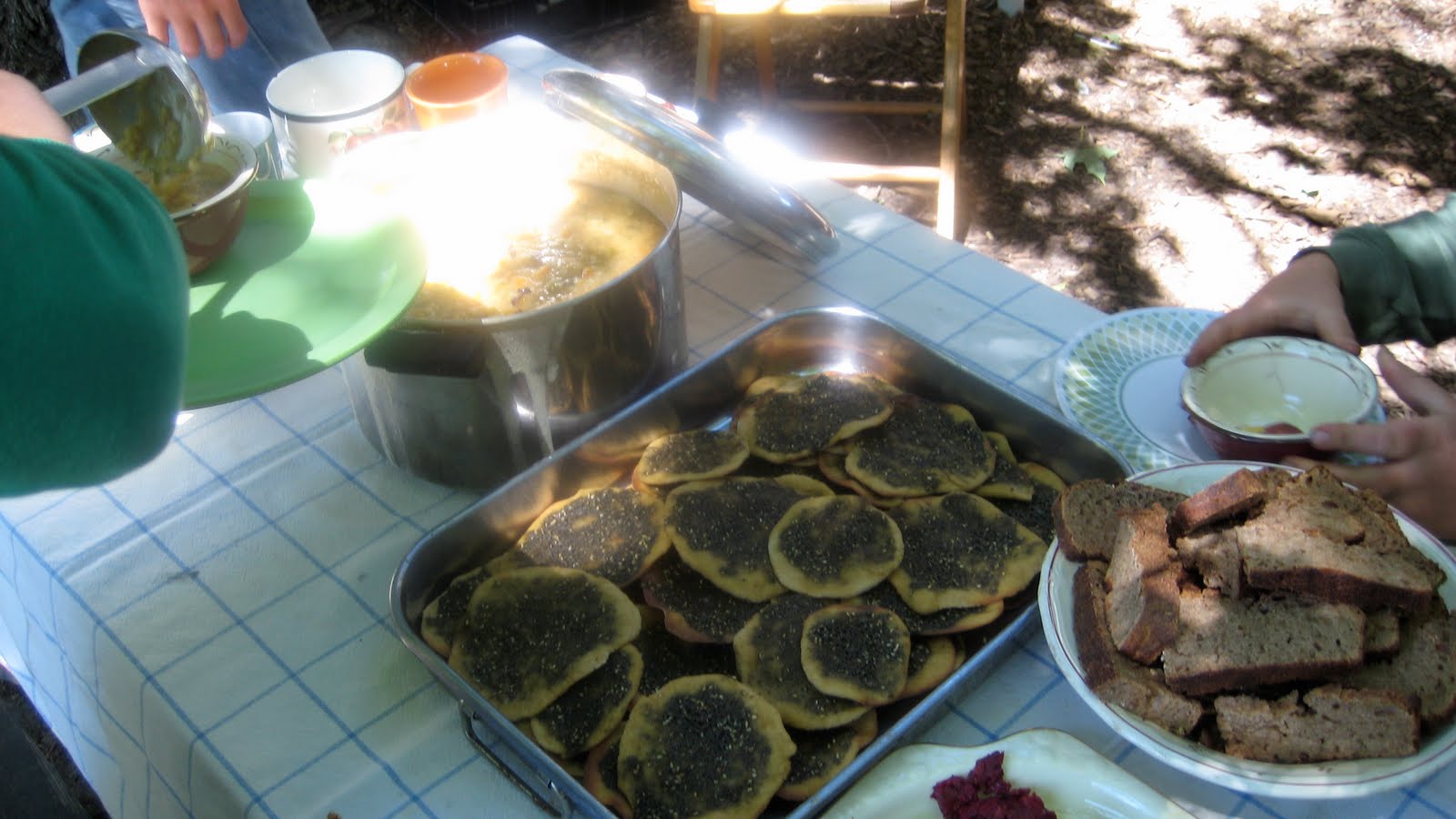
Kurdish spicy pink lentil, rice and chickpea soup with farm onions, celery, carrots and long green peppers plus mint and basil and some chili. It was good and rib sticking.
Za'atar bread--thin and crispy. Lovely.
Sweet and sour Greek zucchini and celery--raisins, honey, red wine vinegar and cinnamon with olive oil of course.
Beet and chickpea falafel patties with sumac, za'atar, lemon and tahini sauce
The beet falafel is from a very new British cookbook from a Bulgarian born Brit named Silvena Rowe. She's 6 feet tall, bleached blond and very very cool.

Madeleine Vedel and her mother Emita Hill helped Maureen and me. It was such fun to have them. Madeleine brought a large loaf of bread. She lives in Avignon in the south of France. If you need a savvy tour guide she's great--owned and ran a cooking school in Arles for many years and now runs private tours--she knows everyone in the area associated with food and wine--and speaks fluent French of course.

Here's a photo of Augustus with Liz, who will be heading off to Ann Arbor for law school in just a few weeks. We'll miss her terribly.

Recipe today is for Greek Sweet and Sour Zucchini (you can add celery if you like)
Adapted from Flavors of Greece by Rosemary Barron

2 pounds zucchini or yellow squash, washed and trimmed
(5 to 6 stalks Meadowlark celery, washed and sliced into 2 inch lengths)
1/3 cup dark raisins
1/4 to 1/2 cup red wine vinegar
4 to 5 tablespoons olive oil
2 teaspoons cinnamon
2 tablespoons honey mixed with 4 tablespoon hot water
Sea salt and freshly ground black pepper
1/2 cup chopped flat leaf parsley
1 tablespoon chopped fresh oregano, optional

Cut squash into 1-inch chunks. Toss with salt.

Mix raisins and 1/4 cup vinegar together.

Heat olive oil in 10-inch deep sauté pan over medium-high heat and add vegetables. When they sizzle, lower heat to low and partially cover. Simmer vegetables until tender, about 8 to 10 minutes. Stir occasionally.

Sprinkle vegetables with cinnamon, raisins and vinegar, honey and water, and season with salt and pepper. Raise heat, shake pan to mix, and cook vegetables uncovered until sauce is syrupy, 3 to 6 minutes. Toss in parsley and oregano. Taste and reseason, adding more salt, pepper and vinegar until the dish sings to you like the siren call: come back come back come back.

If anyone wants the beet falafel recipe I will give it to Jenny. It can be made with Swiss chard, kale, carrots, turnips or rutabaga.

Friday, July 30, 2010

30 July 2010 Buckwheat Groat Day


Today was an ode to buckwheat--and to Auggie's first harissa.

I think of it as winter-hearty food. Nick asked a while back if I'd make something with buckwheat. This week he brought in some roasted groats. I cooked the groats for 15 minutes with about 1 3/4 cup water per cup groats. I mixed them with sautéed onion, garlic and thinly sliced collards stems plus fresh dill and stuffed it all into blanched collards. The Greek egg-lemon sauce poured over lightened the dish to summer satisfaction.

So the menu today was:

Buckwheat stuffed collards with Greek egg-lemon sauce (just egg yolks whisked with fresh lemon juice and cooked slowly until thickened slightly in chicken stock)
Chickpea salad
Harissa (It's the reddish paste in the square white plastic container)
Braised zucchini with onion, garlic and mint

Harissa is a mouth-searing combo of soaked dry red chilies (like Arbol) with seeds and stems removed. They are ground with garlic, ground cumin and ground coriander until fine. Then a bit of salt and olive oil until pasty and creamy-chunky. Keeps a long time. A dab of harissa with something bland like zucchini really wakes you up. As Baby August found out:

There was some betting going on around the harissa. Jon wagered a case of beer if someone would eat a tablespoon of it without washing it down with anything for 10 minutes. Nick and Berkeley considered it, but there were no takers until Berkeley and Jen's baby August decided to show them all up. He swallowed a big glop of it. His eyes popped out in utter shock. But what a guy! He totally kept it together...not a peep escaped those harissa-seared lips. Probably scarred the poor dude for life. When he's 23 he's going to tell the story and complain that Jon did not keep his promise for the case of beer....

At last I've found a use for large zucchini!

Braised zucchini with onion, garlic and mint
6 to 8 servings

4 tablespoons olive oil
1 large or 2 smaller onions, sliced or slivered
4 cloves garlic, finely sliced
2 pounds large zucchini or any type summer squash, cut into 1/2 inch thick chunks
(I usually slice the squash in half lengthwise and then into chunks)
1/4 cup mint leaves
Lemon wedges

Heat the oil in a large, deep pan. Stir in onions and garlic, salt them, and cook over medium heat until onions are tender.

Stir in the zucchini/squash and cover pan. Braise vegetables until zucchini is very tender, about 20 minutes. It should be falling apart. Remove pan from heat and season with salt and pepper.

Toss squash with mint leaves and serve with lemon to squeeze over top.

There is a recipe for bean salad from last year. This time I used chickpeas, onions and red carrots cooked in olive oil, red wine vinegar, basil, Jenny's amazingly sweet celery, lots of parsley and more oil.

Friday, July 23, 2010

Friday 23 July 2010


Today was Spanish again. It arose from leftover ingredients I had from a cooking class called The Spanish Table, that I taught last night at the local college. Today's menu was a complete mystery until I was driving home from the class. I thought that we could easily prepare a paella and a romesco sauce. We do leave a certain amount of the meal to chance. Cucumbers. Potatoes. Dill. Tarragon. Eggs.

I have two paella pans. The 14-inch gets a workout, but the newer 18-inch is for a large crowd and it hadn't been inaugurated yet. Today was the day.

Menu
Vegetable Paella with the elite Calasparra rice from Valencia on Spain's southeast coast.
Romesco Sauce
Sliced Cucumber Salad with Dill
Spanish Potato, Egg and Tarragon Tortilla

Here's a recipe for the Romesco and the Paella.

Arroz de Verduras de Isabel (Vegetable Paella)
This paella is adapted from Penelope Casas’ recipe from a Valencian cook and restaurateur who attributes her success to garden-fresh vegetables--which Meadowlark has in abundance today. Porcini and chickpea cooking liquid give this paella a deep, rich flavor. If you can find Calasparra rice from Valencia, do try it. I brought my small stash accidentally. Normally I'd use risotto type Arborio rice. Same short grain strain of rice, just handled way differently than the Italians do with risotto.
The Arab-Moors brought rice to Spain and ruled it from the 5th or 6th century until the 15th century.
4 to 6 servings

2 cups vegetable or chickpea cooking broth, or chicken broth
1/8 teaspoon crumbled thread saffron
1 ounce dried porcini mushrooms, soaked in 1 cup boiling water, water reserved
1/4 cup olive oil, more as necessary
3 ounces carrots, evenly diced into 1/2-inch cubes
1/4 pound green beans, preferably broad flat beans, ends trimmed
1 medium zucchini, about 6 ounces, cut into 1/2-inch cubes
Sofrito
1 small onion (4 to 6 ounces), finely diced
2 medium red bell peppers, about 1/2 pound, cut into 1/2-inch dice
3 garlic cloves, minced
1/2 to 3/4 cup chopped whole canned tomatoes
1 teaspoon pimentón, Spanish smoked paprika
1 small sprig rosemary
1 cup cooked chickpeas
1 1/4 cups Valencian short grain rice, or Arborio

Combine broth and saffron in a pot. Cover and keep warm over low heat. Bring 1 cup water to boil, remove from heat and stir in mushrooms. Soak till soft, 15 minutes, drain and strain mushroom liquid into broth and saffron.

Chop mushrooms lightly. Preheat oven to 400°F .

Heat half the oil in a 13- or 14-inch paella or oven-proof sauté pan over high heat. Add carrots, mushrooms, green beans and zucchini, and stir-fry till seared and tender, 5 to 7 minutes. Remove to bowl and set aside.

Heat pan with remaining oil and add onion and peppers. Cook until tender, 5 to 7 minutes. Add garlic and cook 2 minutes more, then stir in tomato and cook until it looks thick and jammy, 3 to 5 minutes. Stir in paprika. Return carrot/mushroom/green bean mixture to pan and cook over high heat 1 minute.

Taste and season with salt (mixture should be well salted) and pour in broth. Bring to a boil.

Stir in rosemary, chickpeas and rice, and boil over medium heat until rice is no longer soupy but enough liquid remains to continue cooking rice, 5 minutes.

Transfer paella to oven or to preheated heated Weber grill, and cook, uncovered (but with Weber lid on), until rice is almost al dente, 15 to 20 minutes. Sprinkle with water if rice looks dry midway through cooking time. It should bubble merrily.

Remove pan from oven to a warm spot, cover with foil, and let rice sit 20 minutes. (If you have too much uncooked rice on top, you can flip the rice with a spatula before resting, but don't stir it! Flipping and stirring are not proper paella procedure.)

To make socarrat bottom crust, return paella to stove over medium-high heat. Cook without stirring, 2 minutes, until a crust forms on the bottom of pan (don’t let it burn). Then rest paella covered 20 minutes.

Spanish Romesco Sauce

3/4 cup, 3 ounces, blanched whole almonds or 1/4 cup each almonds, pine nuts and hazelnuts
1 1/2 ounces country bread, toasted and torn
1 medium tomato, sliced in half
2 to 3 cloves garlic
3/4 teaspoon pimentón, smoked paprika
1 pinch cayenne pepper or half of a small dried red chili, seeded
1/2 to 1 teaspoon salt
2 tablespoons red wine vinegar, more as necessary
1/3 to 1/2 cup extra virgin olive oil

1. Preheat oven to 375 degrees F.

2. Spread almonds on a sheet pan and bread on another. Toast until golden, 6 to 10 minutes. Toast hazelnuts and pine nuts on separate pans, 10 minutes. Rub skin off hazelnuts as much as possible. Rub tomato with olive oil and roast cut side down in baking dish until wrinkled and tender, 15 to 20 minutes, and peel.

3. Cool ingredients.

4. Crush nuts, bread, garlic, cayenne and salt together in mortar, or purée in food processor. Add tomato, smoked paprika and vinegar. Purée to smooth paste.

5. Whisk, or drizzle olive oil in with machine running.

6. Taste sauce and season with more salt or vinegar. If mixture is too thick, thin with warm water. Rest Romesco 20 to 30 minutes at room temperature and taste again before serving.
(You may prepare sauce a day ahead; it will keep for over a week refrigerated.)

Romesco is great on raw or steamed vegetables, rice, stirred into soup or on grilled food. In the spring, Spanish folks congregate when the thick green onions (calçots) arrive. They grill the calçots and meat and dip the onions into romesco sauce. It's called a calçotada. And it's a Partee.

Someone at the farm said they love it tossed on pasta. What's not good about that?

Wednesday, July 21, 2010

Pesto and Arugula Day


Friday 16 July 2010

We had almost 20 people for lunch today. Luckily Ella helped Maureen and me. We made a white bean soup with tarragon. I cooked the white beans with lots of garlic--for 2 cups dry, soaked white beans I used four heads of garlic. Peel, don't smash the cloves. They make a mild, flavorful vegetarian broth. Then I sautéed a base of onions, fennel bulbs and baby carrots. The cooked beans, garlic and cooking water went into them with fresh tarragon, turnips and cauliflower. The garnish made the soup come alive: Italian parsley leaves, anchovies, lemon zest (organic please), one dried red chili and olive oil buzzed in the food processor to a textured paste. That went into the hot soup. Yum. Don't be afraid of anchovies! They carry huge flavor. Rinse them if you must. Or try the fresh, glorious tasting white ones.

Then Ella made pesto from the purple basil. It was surprisingly good. I made one from Italian basil. Classic recipe. We tossed it on potatoes and on pasta. It's not uncommon to see the two tossed together with pesto in Genoa.

Someone asked me if I use basil in other ways...I don't use it nearly as much as other herbs, but it's great with peaches, in sweet tea, torn in salad, rolled into Vietnamese summer rolls, in vinaigrettes or tucked into stuffed kale or cabbage rolls. Basil does seem to be best fresh though.

Technique: Classic Basil Pesto (Batuto alla Genovese)
Pesto alla Genovese (of Genoa) is a green sauce that was born in the northwestern Italian region of Liguria, where the Mediterranean/Ligurian Sea warms the land enough to grow olives. (Further inland Piemonte cannot grow olives.) Originally pestos were pounded in a mortar with a pestle, a method that produces a greener—and some say finer—pesto than the more modern food processor. If you wish to mimic the mortar and pestle, place herbs into a heavy plastic baggie and pound them with a meat pounder before processing in food processor. Guliano Bugalli says that basil, garlic, olive oil, pine nuts or walnuts and pecorino or Parmigiano cheese are the true, traditional ingredients.
Makes about 1 cup. Toss on freshly cooked pasta, potatoes or vegetables.

2 ounces (2 cups packed) fresh basil leaves, no stems
1/2 ounce (1/2 cup packed) Italian parsley leaves
1 to 2 cloves garlic, 1 tablespoon chopped, 1/2 ounce
1 ounce (1/4 cup) toasted or raw pine nuts
1/3 cup extra virgin olive oil
1 to 2 ounces (1/4 to 1/2 cup) mixed shredded Parmigiano-Reggiano and/or Pecorino Romano
Optional: 1/4 cup heavy cream

1. Prepare ingredients: Pull leaves from herbs stems, discard stems then rinse leaves and spin or blot dry. To soften garlic flavor, use less or blanch whole, unpeeled cloves in boiling water 30 seconds to 1 minute and peel. Toast nuts if desired and cool before using—it will bring out their best flavor.

2. Purée herbs, garlic, and nuts together in a food processor until smooth; scrape down sides several times.

4. Add oil: With processor running, pour oil into herb-nut purée a thin stream and purée until very smooth. Scrape pesto out into bowl, taste, and season with a little salt (cheese will add saltiness) and freshly ground pepper. Pesto may be frozen at this point—a thin film of oil over the top keeps it from oxidizing into black.

5. To serve: Grate cheese, if using, and toss it with pesto. Adding cheese just before serving assures that the cheese will taste its best. Thin pesto with cream or pasta cooking water before tossing on pasta.

The squash blossoms were out in full force so Ella and Liz picked more than 70 of them and we stuffed them with a mixture of ground turkey chorizo (it was a little too spicy I think), grated yellow squash which I salted for 20 minutes and then squeezed the liquid out of--and some ciabatta bread crumbs. I ground the crumbs and meat separately in the food processor and mixed them with the squash and some fresh thyme. We stuffed the blossoms and laid them into an oiled roasting pan with a little soup broth. Covered them with foil and baked them for 30 minutes at 350F. I uncovered them and let them roast another 5 to 10 minutes. Last year I did them with rice and pork. I think a milder filling is best.

There was a lot of arugula so I had Ella toss it with olive oil and salt then drizzled fresh lemon juice over it. That is hands-down the best way to eat arugula fresh from the garden.

It's paradise at the farm this year. We crave this sunny warm weather interspersed with rain. Though thunderstorms wreak havoc with our electric supply. One freezer tripped off and we didn't discover it for two days. Now everyone will have to eat some of the salvaged--no meat or protein was lost, thank the gods.